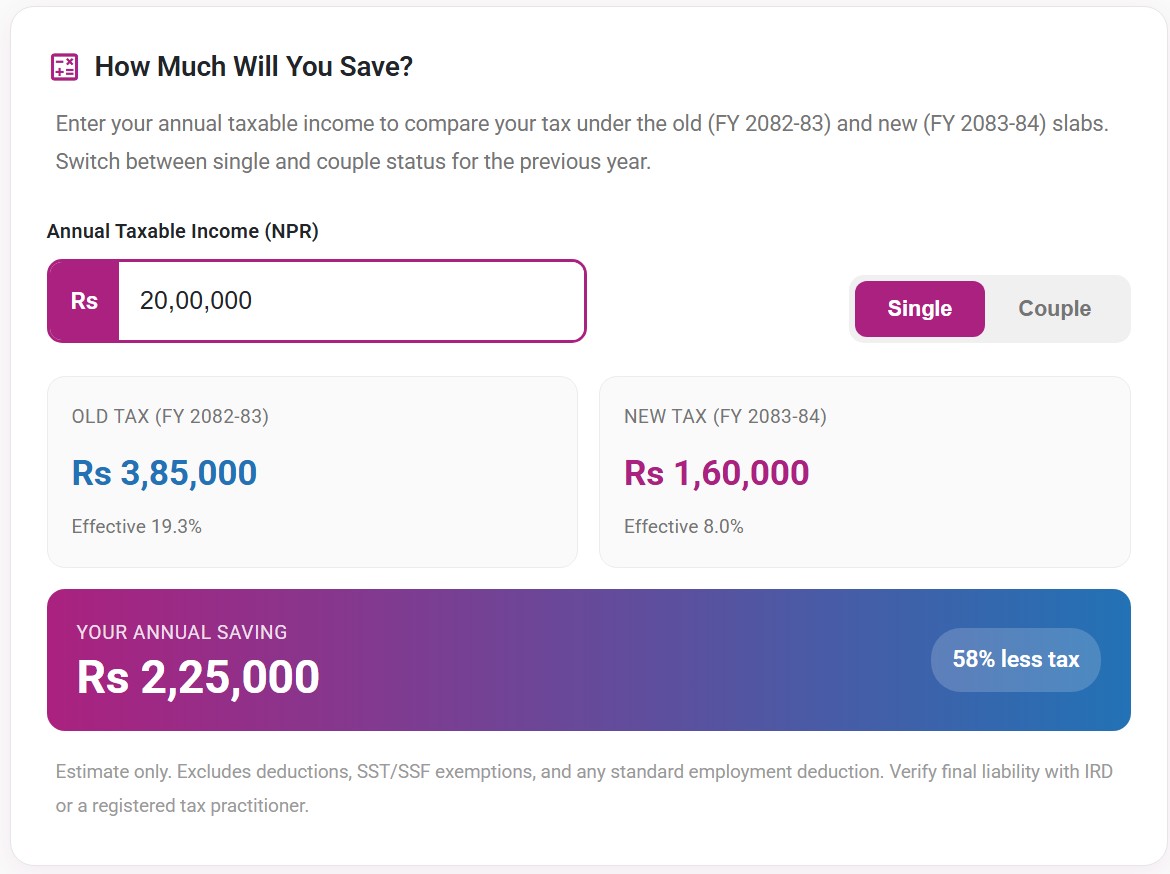
Use this calculator to estimate your Nepal income tax for fiscal year 2083-84 and see how it compares against the previous year's slabs. Enter your annual taxable salary income below and choose single or couple status - the tool shows your tax, effective rate, and the saving from the revised slabs. The new rates apply from Shrawan 1, 2083.
Enter your annual taxable income to compare your tax under the old (FY 2082-83) and new (FY 2083-84) slabs. Switch between single and couple status for the previous year.
How the Calculator Works
The calculator applies each slab in sequence to your income. The first portion of income is taxed at the lowest rate, the next portion at the next rate, and so on - this is how marginal tax bands work. You do not pay a single flat rate on your whole income. The effective rate shown under each result is your total tax divided by your income, which is always lower than your top marginal band.
The single and couple toggle changes the FY 2082-83 figure. In that year, a married couple filing jointly had a Rs 1 lakh higher first-band threshold (Rs 6 lakh instead of Rs 5 lakh), with the bands adjusting accordingly. The FY 2083-84 structure has no separate couple slab announced, so the new-year figure uses the individual structure regardless of the toggle. All figures are calculated on taxable income before any deductions such as life insurance premiums, retirement fund contributions, or the standard employment deduction, so your actual liability will typically be lower than the estimate shown.
Nepal's fiscal year runs from Shrawan 1 to Ashadh end. The FY 2083-84 slabs apply from Shrawan 1, 2083 (mid-July 2026). Income earned in FY 2082-83 - including salary paid in Shrawan for the previous month - is taxed under the old slabs, and the annual return filed in Ashwin 2083 for that year uses the old rates. The new slabs first appear on the Shrawan 2083 payslip.
The Slab Rates Used in This Calculator
The calculator is built on the two slab structures below. The FY 2082-83 column reflects last year's six bands, including the two surcharge rates; the FY 2083-84 column reflects the revised five-band structure announced in the budget.
| FY 2082-83 Slab (NPR) | Old Rate | FY 2083-84 Slab (NPR) | New Rate |
|---|---|---|---|
| First Rs 5,00,000 | 1% (SST) | First Rs 10,00,000 | 1% |
| Rs 5,00,001 - Rs 7,00,000 | 10% | Rs 10,00,001 - Rs 15,00,000 | 10% |
| Rs 7,00,001 - Rs 10,00,000 | 20% | Rs 15,00,001 - Rs 25,00,000 | 20% |
| Rs 10,00,001 - Rs 20,00,000 | 30% | Rs 25,00,001 - Rs 40,00,000 | 27% |
| Rs 20,00,001 - Rs 50,00,000 | 36%* | Above Rs 40,00,000 | 29% |
| Above Rs 50,00,000 | 39%** |
* 36% = 30% base + 20% surcharge on Rs 20L to Rs 50L. ** 39% = 30% base + 30% surcharge above Rs 50L. The 1% first band was a Social Security Tax (SST); SSF contributors were exempt. Confirm SST/SSF treatment under the new structure with IRD.
This calculator estimates tax on taxable salary income only. It does not handle business income, capital gains, rental income, or income from investment, each of which follows separate rules under the Income Tax Act 2058. For a household with multiple income sources, the combined liability must be computed across all heads - consult a registered tax practitioner for a full assessment.
Frequently Asked Questions
It gives a close estimate of tax on salary income before deductions. Your final bill is usually lower because allowable deductions - life insurance premiums up to Rs 40,000, retirement fund and SSF contributions, approved donations - reduce taxable income before the slabs are applied. The calculator also does not account for the SST exemption that applies to SSF contributors on the first band. Treat the result as a planning figure, not a filed return, and confirm with IRD or a tax practitioner.
Enter your annual taxable salary income - gross annual salary less any tax-exempt allowances and before deductions. If you receive a monthly salary, multiply it by 12 (or by 13 if you receive a festival bonus equal to one month's pay, which is taxable). The calculator then applies each slab band in sequence to that total.
Yes - use the Couple toggle above the income field. It applies the FY 2082-83 married couple slabs, which started the first band at Rs 6 lakh instead of Rs 5 lakh. The FY 2083-84 structure has no separate couple slab announced in the budget, so the new-year figure uses the individual structure for both statuses. Whether the new structure will carry a higher couple threshold should be confirmed with IRD once the final Finance Act is published.
Take the Next Step
If you run payroll for a team and need TDS computed correctly against the new slabs every month, explore payroll tools built for Nepal compliance or speak with a tax professional.