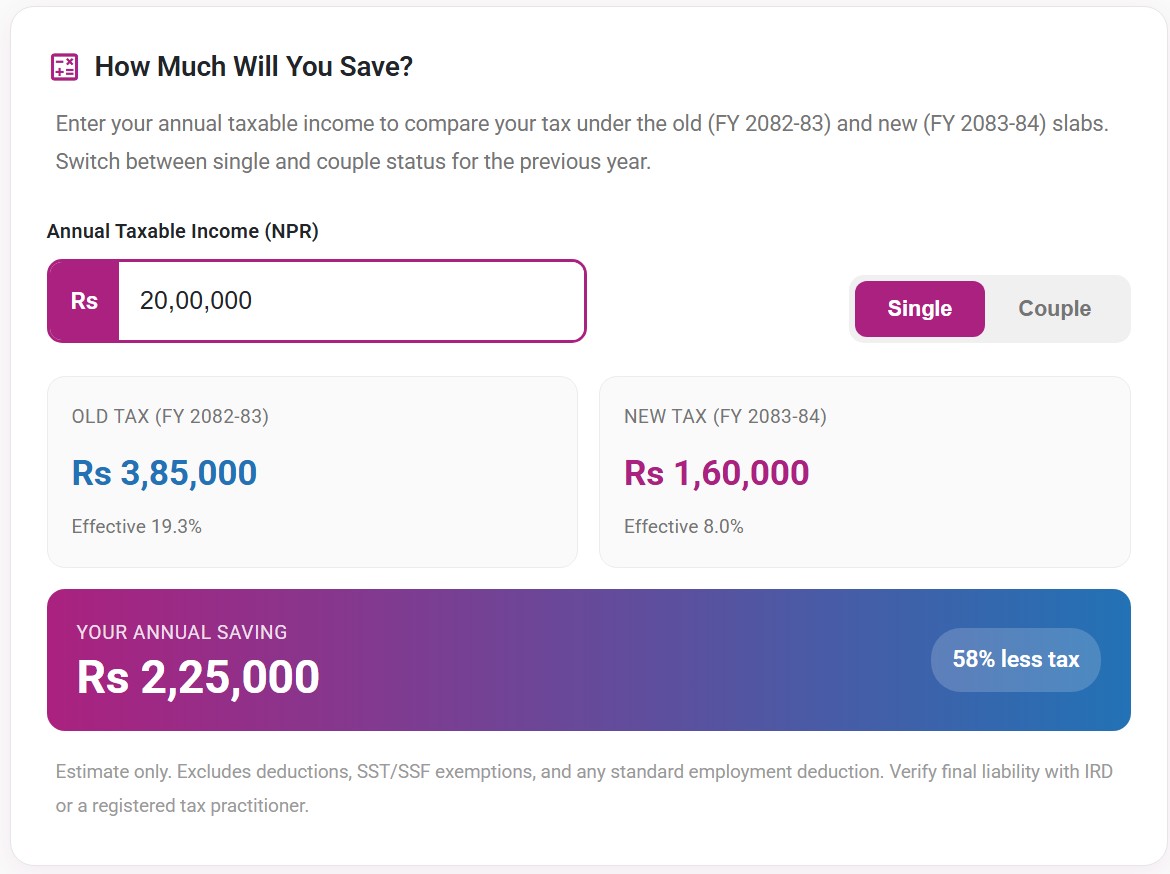
Nepal's FY 2083-84 budget revised the personal income tax slabs significantly, and for almost every salaried person the result is a lower annual tax bill. The first 1% band now covers income up to Rs 10 lakh, the 30% band is gone, and the old 36% and 39% surcharge rates have been replaced by a single 29% top rate. The practical question for most people is simple: how much will I actually save? This article answers that with a live calculator and a savings table at every common salary level.
Enter your annual taxable income to compare your tax under the old (FY 2082-83) and new (FY 2083-84) slabs. Switch between single and couple status for the previous year.
The new rates apply from Shrawan 1, 2083. Your first payslip of the new fiscal year is where the lower tax shows up. The savings below are calculated on taxable income before deductions, so your real saving may differ once life insurance premiums, retirement contributions, and other allowable deductions are applied.
Your Savings at Every Salary Level
The table below shows the annual tax under both regimes for a single individual, along with the saving and the percentage reduction. These are computed on taxable income with no deductions applied, so they represent the maximum tax in each case - your actual figures will usually be lower.
| Annual Income | Old Tax (82-83) | New Tax (83-84) | You Save | Cut |
|---|---|---|---|---|
| Rs 7,00,000 | 25,000 | 7,000 | 18,000 | 72% |
| Rs 10,00,000 | 85,000 | 10,000 | 75,000 | 88% |
| Rs 12,00,000 | 1,45,000 | 30,000 | 1,15,000 | 79% |
| Rs 15,00,000 | 2,35,000 | 60,000 | 1,75,000 | 74% |
| Rs 20,00,000 | 3,85,000 | 1,60,000 | 2,25,000 | 58% |
| Rs 25,00,000 | 5,65,000 | 2,60,000 | 3,05,000 | 54% |
| Rs 40,00,000 | 11,05,000 | 6,65,000 | 4,40,000 | 40% |
| Rs 50,00,000 | 14,65,000 | 9,55,000 | 5,10,000 | 35% |
The percentage cut is largest for middle incomes - someone at Rs 10 lakh sees an 88% reduction in tax. In absolute rupees, higher earners save more, but as a share of income the new regime delivers the sharpest relief to the Rs 8-15 lakh salary range.
Who Benefits the Most
Three groups see meaningful change. Earners between Rs 5 lakh and Rs 10 lakh, who previously paid 10% and 20% on the upper part of their income, now fall entirely within the 1% band - the largest percentage cut of any group. Mid-level managers between Rs 12 lakh and Rs 25 lakh escape the old 30% band, which has been removed completely. Senior earners above Rs 40 lakh benefit from the collapse of the 36% and 39% surcharge bands into a flat 29%, which caps their marginal rate well below the old peak.
The saving lands from the Shrawan 2083 payslip onward, not on the return you file in Ashwin 2083 for FY 2082-83 - that return still uses the old slabs. If you contribute to the Social Security Fund (SSF), the 1% Social Security Tax on the first band did not apply to you last year, so your starting point differs slightly from the table above. Confirm how the new structure treats SST for SSF contributors with IRD.
The savings shown are before deductions. Claiming allowable deductions - life insurance premiums up to Rs 40,000, retirement and SSF contributions, approved donations - reduces your taxable income before the slabs apply, lowering your tax under both regimes. The rupee value of each deduction is slightly lower now at the top end because the highest rate fell from 39% to 29%, but the overall burden is still far lower.
Check your own number with the calculator above rather than relying on a salary-band average. Two people on the same gross salary can have different taxable income after allowances and deductions, and the saving scales with where your income sits across the bands.
Frequently Asked Questions
From the Shrawan 2083 payslip, which is the first month of fiscal year 2083-84. Your employer should apply the new slabs to monthly TDS from that point. If your Shrawan payslip still shows the old deduction, raise it with payroll - the slab table may not have been updated. The annual return for FY 2082-83, filed in Ashwin 2083, still uses the old rates and does not reflect the new savings.
Taxable income is not the same as gross salary. Allowances, deductions, SSF contributions, and filing status (single or couple) all change the taxable figure that the slabs apply to. Two people with identical gross pay can land in different positions across the bands, producing different tax and different savings. Use the calculator with your own taxable income for an accurate result.
No. The table and calculator compute tax on taxable income before deductions, so they show the maximum tax in each case. Your real tax will usually be lower once life insurance premiums, retirement fund contributions, and other allowable deductions are applied. The saving between the two regimes remains, but both your old and new tax figures shift down once deductions are factored in.
Take the Next Step
If you manage payroll and need every employee's TDS recalculated correctly against the new slabs before Shrawan, explore payroll tools built for Nepal compliance or speak with a tax professional.